Korean Kiosk Ordering Guide: A Practical Guide for Foreign Travelers
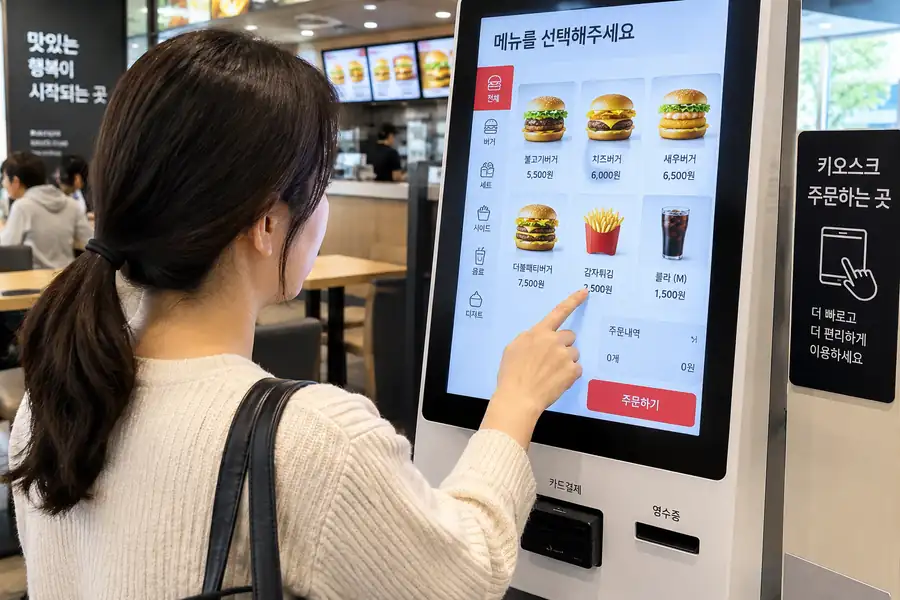
While traveling in Korea, you may have to order at a restaurant or cafe through a kiosk instead of speaking to a staff member. If you are not used to choosing a menu and paying on a screen, the first moment can feel a little confusing.
Knowing in advance whether an English menu is available, how eat in and takeout are separated, whether your overseas-issued card will work, and where you collect your food makes the whole process much easier.
A few days ago, I took my parents to a hamburger shop near our home. It was lunchtime, the store was crowded, and instead of a cashier waiting at the counter, a large self-service kiosk stood near the entrance. Young students tapped through the screen without thinking twice, but my father stopped for a moment on the first page. Eat in or takeout, coupon or no coupon, drink change or regular set. The machine kept asking questions, and the line behind us made the screen feel even more intimidating.
Foreign travelers in Korea often meet the same moment. You walk into a restaurant, but no one comes to take your order. People are standing in front of a machine by the door. The screen has food photos, but the buttons are unfamiliar. Then, at the final payment step, your card may suddenly fail. That is why learning Korean kiosks is not just about a machine. It is a small but important piece of everyday Korea.
So with Korean kiosks, it helps more to understand how ordering works in Korean restaurants and cafes than to memorize how to operate one machine.
What to Check First on the Kiosk Screen
When you stand in front of a kiosk, do not start by pressing the food photos. First, scan the corners of the screen. The language button is often small. It may say English, ENG, Language, or appear as a globe icon. It is usually near the top or bottom edge. Switching language first can save you from backing out later.
Even if there is no English menu, you do not need to panic. Food photos and prices are usually visible, and you can always ask a staff member about anything you do not understand.
The next common question is whether you will eat inside or take the food away. On Korean screens, 매장 (maejang) means eating in the store. 포장 (pojang) means takeout. You may also see icons of a tray or a paper bag. In cafes, the machine may ask whether you want a store cup, disposable cup, or personal tumbler. If you choose the wrong one, do not panic. Before payment, most machines still let you go back or cancel.
The menu stage is where many travelers relax too early. Choosing the burger, coffee, noodles, or rice bowl is only the beginning. The kiosk may then ask about size, spice level, set menu, side dish, drink, sauce, ice, toppings, or extra packaging. This is where my father usually turns to me and says, "Why is it asking so many things?" He is not wrong. Korean kiosks can be efficient, but they can also feel like a questionnaire. So check the quantity and the price once more on the final confirmation screen before you pay.
What to Know About Payment
Most Korean kiosks are built around card payment. If your card has an IC chip, insert it into the card reader below the screen. If contactless payment is supported, tap the card or mobile wallet on the reader.
Still, not every store supports the same payment methods, and some overseas-issued cards may not go through. That does not mean your card is broken.
After payment, take the receipt or order ticket. Do not throw it away. Many Korean shops do not call your name. They show an order number on a screen above the pickup counter. In food courts and cafes, you watch the display, then go up when your number appears.
Asking Staff for Help Is Perfectly Fine
Pausing for a moment in front of a kiosk is not embarrassing. In Korea too, many people are not used to kiosks, and older customers in particular can find new machines difficult.
When I go to a restaurant with my parents, I sometimes press the screen for them. So it is only natural for a foreign traveler to hesitate in front of a Korean screen they are seeing for the first time.
You do not need polished Korean to get help. If you point to the screen and say "Do-wa-ju-se-yo", it means "Please help me." If your card does not work, say "Ka-deu-ga an dwae-yo", which means "The card is not working." If you want to ask about English, say "Yeong-eo menu isseo-yo?", meaning "Is there an English menu?"
And an overseas-issued card does not work smoothly on every kiosk. If payment keeps failing, show the screen to a staff member and ask for help instead of repeating the same step. Asking whether you can use another card or another payment method is also a good idea.
Where Do I Pick Up My Food?
Paying at the kiosk does not always mean you can sit down and wait. In many stores, the kiosk finishes the order, but the food pickup is still your job. My parents once assumed that a staff member would bring the food to the table. Then they noticed everyone walking to the pickup counter when numbers appeared on the screen. That small step is easy for locals but confusing for first-time visitors.
Pickup style depends on the store. At highway rest stops, fast-food chains, and large cafes, you usually wait for a number on the display or a buzzer, then collect the food yourself. Some restaurants place a small tablet kiosk on each table instead. You order and pay right there, and a staff member or a serving robot brings the food to your table. Many ordinary restaurants also bring the food to your table, but some expect you to collect it yourself.
So after ordering, check whether there is an order number or a buzzer, and look around for a pickup counter. If you are not sure whether to wait at the table or collect the food yourself, ask a staff member, "Where do I pick up my food?"
Water, cutlery, napkins, side plates, and tray return are also often self-service. If staff do not bring them, that is normal and not a sign that your order went wrong. Look for a self-service corner, a sign near the counter, or a note on the table.
If You Are Worried About Ingredients and Allergies
If you have a food allergy, do not judge from the picture or the name alone. Ask a staff member about the ingredients. Some dishes, especially soups and sauces, hide ingredients that are not easy to see.
A Practical Kiosk Guide for Korea Travelers
You do not need to know all of Korean to use a kiosk well. Check the language setting on the first screen, choose eat in or takeout, then pick your food and options. Confirm the quantity and price, pay, and check the order number or buzzer.
Just remember that the way you receive your food can differ from store to store. Some places expect you to pick it up yourself, and others bring it to your table.
Check the first screen for an English button before anything else.
매장 means eat in, and 포장 means taking the food away.
Check the menu, quantity, options, and total once more before paying.
If a foreign-issued card fails, use another payment method or ask a staff member for help.
If you get an order number or a buzzer, keep it until you receive your food.
Check whether the store is self-pickup or table service.
It also helps to check whether water, cutlery, and napkins are self-service.
Kiosk culture in Korea is fast and convenient, but it can feel unfamiliar at first. For a foreign traveler in particular, the small things can be confusing, from the Korean-only menu to where you collect your food and where the water and cutlery are.
But once you know the basic flow, it is not as hard as it looks. Read the screen slowly, and ask a staff member whenever something is unclear. So do not be too nervous if you meet a kiosk for the first time in Korea. After using one or two, the next one will feel much more familiar.
📌 Recommended Posts
이 리뷰를 한국어로 읽고 싶으신가요?
🇰🇷 한국어 리뷰 읽기