Free Wi-Fi in Korea: From Seoul Subways to K-Hiking Trails
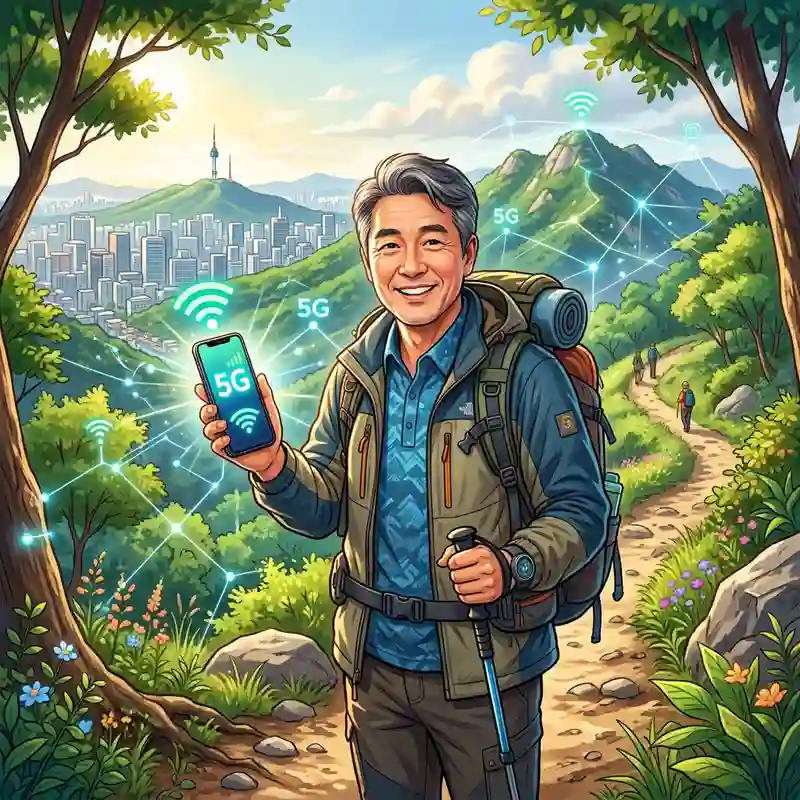
Whenever I walk around the streets of Seoul these days, I find myself surprised more than once or twice. Whether I'm on a moving subway or bus, or even somewhere like Bukhansan that I often visit on weekends, I can use the internet and data quickly on my smartphone. South Korea's high-standard communication environment feels completely natural now, but the internet and communication environment in my memory was very different from today.
- World-class, high-standard gigabit internet and free public Wi-Fi infrastructure.
- Availability not only in everyday spaces such as subways, buses, and stores, but also in some mountains and national parks.
- An important means of communication that helps hikers check on their safety and request rescue in an emergency.
Memories of Wandering in Search of Base Stations 30 Years Ago
It has already been 30 years since I first bought a cell phone. Back then, cell phones were astronomically expensive and almost as big as a brick. The colors were not as varied as they are now, and most of them were black. But what was most different from today was the call quality.
Back then, it was hard even to imagine using mobile data as freely as we do now. If you stepped just a little outside the city center or went down into a building's basement, the call would invariably cut out or the signal would weaken. So whenever I had to make or receive an important call, it was common to hold my phone up and move around, wandering in search of a spot where the signal came through well.
The same was true when I called my elderly parents in the countryside to check on them. The signal would not reach well inside their home, so I still vividly remember them telling me how they had to rush out into the yard to answer my call, or even climb the highest hill in the neighborhood just to manage the conversation.
If I told my kids today, they might not believe it and would call it a story from the days when tigers smoked cigarettes. But back then, the mere fact that we could share voices with someone far away, even with such effort, felt truly amazing and something to be grateful for.
The Frustration of the Days When We Chased Wi-Fi
Even when smartphones first appeared and the concept of Wi-Fi was just beginning to spread widely, the inconvenience remained. Because data plans were expensive, we struggled to catch free Wi-Fi wherever we could, yet the signal was weak even inside our own homes, so we hovered around the router. Even when we happened to find free Wi-Fi at a cafe or a public place and managed to connect, the loading time was so long that we had to wait a good while for a single webpage to appear.
It took patience just to receive or send a single message on a messenger app, and while watching videos that stuttered and cut out from buffering, we were simply amazed that we could use the internet on a smartphone at all. It was a frustrating and slow speed, but at the time it was the best we had, and I marveled at the mere fact that a new technology had appeared.
Looking back calmly, it was only a little over a decade ago, yet now it feels like a truly distant memory. Back then, it was hard to imagine that the internet and communication environment would change this much in just a few years.
The Present, When the Entire City Has Become a Giant Network
Today, however, the communication environment of South Korea has changed completely from the past. When I think about my daily morning commute, from the moment I leave home until I arrive at the office, I can naturally use the internet and mobile data even while on the move. The environment is well equipped so that I can use mobile data and public Wi-Fi not only at neighborhood bus stops or inside buses, but also inside crowded subway cars.
When I take my son to a large shopping mall downtown on weekends or have a meal at a restaurant, I can easily find free Wi-Fi. Many public and commercial facilities such as government offices, bus terminals, and cafes also provide Wi-Fi. If connecting to the internet itself was inconvenient in the past, now checking a webpage, watching a video, or exchanging files while on the move has become a completely natural part of daily life.
Recently, foreign tourists have also shown interest in so-called 'K-Hiking (city hiking)', which means climbing the mountains in the heart of Seoul. Being able to use a map app or stay in contact with family while climbing a mountain is a considerable change compared with the past. In particular, on mountains close to central Seoul such as Bukhansan, there are many sections where mobile communication works even during a hike, which makes me feel how much times have changed compared with the days when I had to move around searching for a signal.
What impresses me most is that the communication environment goes beyond simple convenience and connects to safety. Tourists visiting Korea often do not have free use of data, and mobile communication plays an important role in checking the route during a hike, letting family know their current location, and requesting rescue in an emergency. The fact that free Wi-Fi is more widely available feels all the more welcome and reassuring to me, who lived through those frustrating days of the past.
A Practical Guide to Korea's Free Wi-Fi for Foreign Tourists
To safely and conveniently enjoy Korea's free internet, remember these three things.
- Check the Cafe Receipt and the Area Near the Counter (Cafe WiFi Passwords): Almost every food and beverage establishment in Korea, from large franchises like Starbucks to small neighborhood cafes, offers free Wi-Fi. The password is usually written at the bottom of the receipt you receive after ordering or near the register, so refer to that, and if you still have trouble finding it, most staff will kindly tell you the Wi-Fi password if you ask.
- Subway and Bus Connection Tips (Public Transit WiFi): On public transportation and in public places, you can connect to free public Wi-Fi networks.
- Auto-Connect Tip: Select Public WiFi Secure from the list and enter wifi for both the Identity and the Password. You connect to a security-enhanced encrypted network, and once you set it up, it automatically connects on other public transit nationwide without needing to authenticate each time, which is extremely convenient.
- When the Login Window Doesn't Appear: If the authentication window does not appear automatically, open a browser such as Safari or Chrome and try accessing any website (for example, example.com). You will be forced to the free authentication screen automatically. (Note: Re-authentication may be required when the mode of transport changes, such as transferring from the subway to a bus.)
- Security Warning and Safe Data Use (Security Warning): Korea's public Wi-Fi is very fast and convenient, but because it is an open network, security vulnerabilities may exist. When entering sensitive personal information such as internet banking or credit card payments, it is safer to turn off public Wi-Fi for a moment and use the cellular data of a travel SIM or eSIM, or, if unavoidable, to be sure to activate a trusted VPN app before using it.
📌 Recommended Related Posts
이 리뷰를 한국어로 읽고 싶으신가요?
🇰🇷 한국어 리뷰 읽기