Sending Packages in Korea: A Foreigner's Delivery Guide
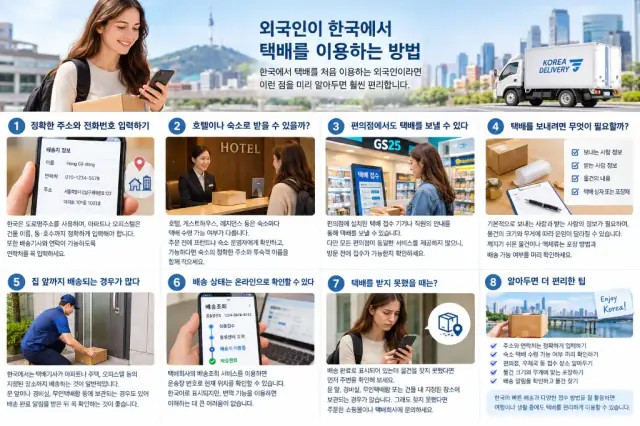
A month ago, I had to send some clothes to my mother, who lives in the countryside. I bought the clothes she wanted at a department store, stopped by a convenience store near my home, and sent them by parcel. In front of the self-service machine, I checked the sender's name and the recipient's address, entered the tracking number, and the whole thing took less than a minute. I had already checked the weight of the clothes and the box in kilograms through a delivery app on my phone and made a reservation before I left home.
But at the next machine, a young foreigner stared at the screen for a long time and finally called a staff member for help. It is a routine we know too well, but for someone doing it for the first time, it is an unfamiliar process.
If you are visiting Korea or staying for a few months, there will be times when you need to send a parcel. You might order something online, ship home the things you bought while traveling, or send items ahead when you move between accommodations. Korean delivery reaches most of the country quickly and the fees are not heavy, so once you learn the basics, both travel and daily life get much easier.
For a first-time foreign user, though, the details are confusing. How should you write the address? Is a phone number really necessary? Can you receive a parcel at a hotel? So today I will walk through what I have experienced myself and what I have explained to foreign friends, step by step.
The First Wall Foreigners Hit at a Korean Convenience Store
The first barrier in Korean parcel delivery is not the act of sending something. It is the screen where you enter the information.
The very first thing to check is the size and weight of the box in kilograms. The price depends on both, and if you get it wrong, the convenience store machine may refuse the parcel entirely. On the machine or an online order form, you then enter the sender's and recipient's names, phone numbers, and addresses in order. The screen is in Korean by default, so it is easy to freeze when you do not know what goes where. I recommend reading up in advance or asking a staff member for help.
The second barrier is the address format. Korea uses road name addresses as the standard, so the order and structure differ from what you may be used to. The main road name and building number come first, and the district and unit number follow afterward.
The third is the phone number. In Korea, delivery drivers often need to contact the recipient, so a reachable number is essential. If you leave only an overseas number, the driver may fail to reach you at the final step and the parcel can be returned to the sender. If you understand just these three things, you already grasp half of how Korean delivery works.
What to Check Before the Address: Road Names and Unit Numbers
When you order a parcel in Korea, the first thing to confirm is the delivery address. Korean addresses are based on road names, and for apartment buildings you usually add the building name and the unit number as well.
If you live in an apartment, a road name address alone is not enough. Many buildings share the same road and the same number, so you need to write exactly which building and which unit. The same applies to officetels and studio apartments. If you leave out the unit number, the parcel can end up at the wrong door.
The apartment complex I live in has more than twenty buildings. Even within the same street number, the entrance location changes completely depending on the building number, so a single missing line can send a parcel to the wrong place or back to the sender.
When you write the address, checking the English version on Naver Map or Kakao Map is also useful. However, if you enter only the English address, the driver may have trouble reading it. It is safer to put the Korean address on the order form and keep the English version for your own reference.
Without a Phone Number, Your Parcel Gets Returned
In Korean delivery, a phone number is not optional. It is effectively required information. Right before a parcel reaches your door, the driver often calls the recipient to confirm the location or ask whether to leave it with the security office.
If you have a Korean mobile number, writing your own number is the easiest option. You can get a number with a prepaid SIM or a budget carrier plan, so if you plan to stay more than a few weeks, it is worth preparing one.
If you do not have a number, you can list the contact of your accommodation or a friend instead. In that case, though, that person has to be able to answer the phone for you, so it is polite to ask them in advance.
When I send parcels to my mother in the countryside, I always write both her contact and mine. If she cannot pick up, I want the driver to reach me, so I add my number as a backup.
If you leave only an overseas number, the driver may hesitate to call because of international call charges. In that situation, leaving a reachable Korean number in the memo field of your online order helps a lot.
Can You Receive a Parcel at a Hotel or Guesthouse?
Whether you can receive a parcel at a hotel, guesthouse, or residence depends on the place. Some front desks hold parcels for guests, while others do not accept personal deliveries at all.
So before you order, it is safer to ask the front desk or the accommodation operator first. When you ask, check three things together: whether they can receive it, where they store it, and how the recipient name should be written.
If they say yes, write the exact address of the accommodation along with the guest name clearly on the delivery details. If your English name differs from your passport name, the front desk may struggle to verify you, so use the same spelling you used for the booking.
If you are staying only briefly, also confirm the expected delivery date. If the parcel arrives after you have already moved to another city, retrieving it becomes a real hassle. If your checkout date overlaps with the delivery date, tell the front desk in advance or simply have it sent to a different address.
This is the advice I give foreign friends most often. Many people order first without asking the accommodation, and if no one is there to receive it, the parcel eventually goes back.
Convenience Store or Post Office: Where Should You Send It?
When you need to send a parcel yourself in Korea, your main options are a convenience store, a post office, or a general courier service. You can find them almost anywhere, but each works a little differently.
Convenience store delivery is the most accessible. You can hand over your parcel through the self-service machine or with a staff member's help, and you can send it late at night. It is handy when you need to ship a small item to another region while traveling or when the post office hours do not fit your schedule. General courier services are harder for foreigners to use, so I recommend avoiding them.
Not every convenience store offers the same delivery service, though. The partner courier and the accepted items can differ by store, so it is worth checking before you visit. Large or fragile items are sometimes refused at convenience stores.
The post office covers a wider range. You can send domestic parcels and international ones, and you can buy packing boxes on site. However, many branches operate only on weekdays, which can be hard to match with a travel schedule.
The sending process is similar either way. You write the sender's and recipient's names, contacts, and addresses, tell the staff what is inside, and pay.
Here is the information worth preparing before you send a parcel.
-
Sender name and contact number
-
Recipient name and contact number
-
The recipient's exact address including building and unit number
-
The contents of the parcel and an approximate value
-
A box that fits the item and cushioning material
Fragile items and liquids need extra care. Check the packing method and whether the item can be shipped at all, and ask for a handling label if needed.
Delivery at the Door, and What Happens After
Korean parcels are often delivered right to your door. In an apartment, the parcel comes past the shared entrance to each unit. In an officetel or studio, it arrives at a designated spot inside the building.
The catch is that drivers frequently leave the parcel at the door or a designated place instead of handing it to you directly. This is commonly called door delivery, and it is a practical way to hand over a parcel safely when nobody is home.
So when you get a delivery complete notification, check for the parcel as soon as you can. The notification usually includes a photo of the box at your door, so you can guess where it was left. In my case, I check the notification during work and pick up the box in front of my door after I get home.
If you live in an apartment or officetel, parcels are sometimes left with the security or management office. They may ask for identification, so having your ID or unit information ready helps. If your complex runs unmanned lockers, you can enter the code sent by text message to retrieve your parcel.
The drop-off location can vary depending on the building rules, so if it is your first time staying somewhere, ask the front desk or management office where parcels are left.
When the Tracking Screen Is Only in Korean
Major Korean courier companies let you check delivery status with a tracking number. If you ordered from an online shop, you can often find the delivery status and tracking number on the order page.
With a tracking number, you can enter it into the courier's tracking service and see where your parcel is right now. The process usually runs from acceptance, to sorting center transfer, to arrival in the delivery area, to handover to the driver, to delivery complete. Once you understand the flow, following the steps is not difficult.
The tracking screen, however, is mostly in Korean. When that happens, using your browser's translation feature or taking a screenshot and running it through a translation app works well. The steps themselves are simple, so knowing just a few words is enough to read your current status.
Here are the terms you will see most often on a tracking screen.
-
Acceptance: the courier has registered the parcel
-
Line-haul loading: the parcel is moving to a regional sorting center
-
Out for delivery: the driver has loaded the parcel and started the route
-
Delivery complete: the parcel has arrived at its destination
Even if the words look unfamiliar, knowing the order lets you guess which stage you are at.
What to Do When Your Parcel Never Arrives
If tracking says delivery complete but you cannot find the parcel, first look around the delivery address. In Korea, parcels are often left at the door, with the security office, in an unmanned locker, or at a designated spot inside the building.
In an apartment or officetel, check whether it was left with the security or management office. Wrong deliveries to a neighboring unit are not rare either, so looking at the door next to yours can help. I have personally received a neighbor's parcel by mistake and passed it along more than once.
If you still cannot find it, contact the courier company that handled the order. If you need to reach the driver directly, use the contact number shown on the tracking screen or make the request through the shopping mall's customer service.
When you call, giving the tracking number or order number speeds things up. Sharing when you noticed the parcel was missing and when you received the delivery complete notification also makes the situation easier to explain.
If the parcel is lost, the courier company and the shopping mall handle the compensation process. If a delivery complete photo exists, however, determining responsibility can take time, so checking notifications and picking up your parcel promptly is the most reliable prevention.
Quick Summary Before You Use Korean Delivery
Korea's parcel system is not hard to use once you know a few basics, even for a first-time foreign visitor. The most important things are an accurate address and a reachable phone number.
If you plan to receive a parcel at your accommodation, confirm with the front desk first and check whether the delivery date falls after your checkout. If you need to send something yourself, choose between a convenience store and a post office based on your schedule, and prepare packing that fits the item. Even if the Korean on the screen feels unfamiliar at first, two or three tries are usually enough to get used to it.
At the post office, boxes in various sizes are available for purchase, so you can simply buy one and use it.
At a convenience store, simple items like clothing can go in a plastic delivery bag, and larger items need a cardboard box.
You can buy plastic delivery bags online, and cardboard boxes are sold online or sometimes given free at small neighborhood marts, so ask a staff member there.
📌 Recommended Posts
이 리뷰를 한국어로 읽고 싶으신가요?
🇰🇷 한국어 리뷰 읽기