Korean Restaurant Call Button: How to Get Service Fast
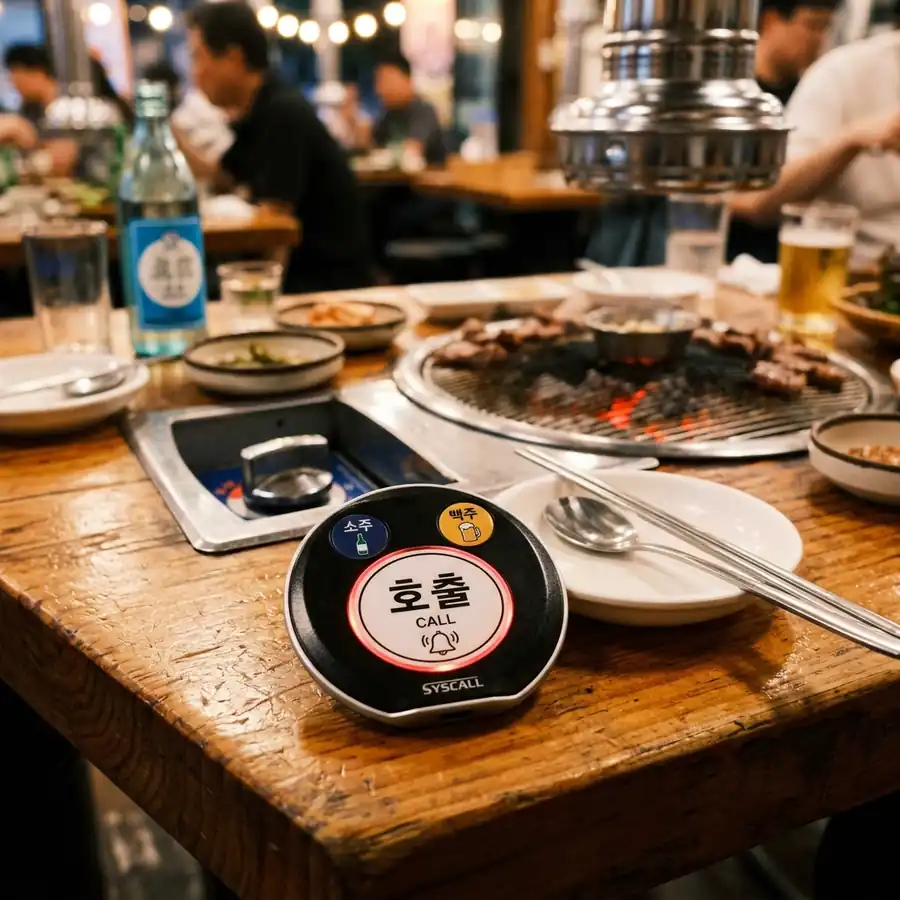
The other day, I went out for dinner with my family to a bustling Korean BBQ restaurant near our house. Filled with the smell of grilling meat and the chatter of people, the restaurant was incredibly crowded. Yet, even in this chaotic environment, there is absolutely no need to crane your neck to make eye contact with a waiter or shout across the room. Everything is seamlessly resolved by a small 'Call Button' quietly attached to the corner of the table.
- A fast and efficient Korean dining culture where you can call staff with a single button without waiting.
- The evolution of practicality, featuring dedicated 'Soju' and 'Beer' buttons.
- A practical guide on how to confidently use the table call button when visiting a Korean restaurant.
1. The End of the Waiting Game: Birth of the Call Button
The table call button in Korea was naturally born out of our 'Ppalli-Ppalli' (hurry-hurry) culture, which constantly seeks speed and efficiency. In the past, before these buttons existed, simply calling a staff member in a busy restaurant was an exhausting task. We had to shout "Excuse me!" or "Auntie!" at the top of our lungs, and in a noisy environment, it often took several attempts to just get their attention. From the staff's perspective, it was equally frustrating when multiple tables called out at once, leading to confusion over who called first.
However, with the introduction of call buttons on every table, this inconvenience vanished like magic. The moment you press the button, a clear "Ding-dong" rings out, and your table number lights up on a display board on the wall. Some restaurants now send a vibration alert to the staff's smartwatch or a dedicated call device. Customers no longer have to lose their voice shouting, and the staff can see right away which table called, which makes serving noticeably easier.
2. Ultimate Practicality: Dedicated Soju and Beer Buttons
The Korean restaurant culture that values efficiency has grown beyond simply calling a staff member in many different ways. Reflecting the culture of company dinners (Hoesik) and the nature of BBQ joints and pubs, the design of the bell itself has evolved. At some BBQ joints and pubs, you can even see a call button split by purpose into 'Soju', 'Beer', and 'CALL'.
As a drinking session gets lively, the frequency of ordering more alcohol naturally increases. Instead of pressing the regular bell, waiting for the staff, and then saying, "Please give us one more bottle of Soju," you just press the 'Soju' button on the table. The staff checks the table number and the request shown on the display board or call device, then brings the order over. It is a practical system that cuts down the back-and-forth of confirming an order and then bringing the drinks.
3. The Shift to Digital Tablet Menus
Recently, this table bell system has evolved a step further, with many restaurants installing 'digital menus' (tablet PCs) right at every table. At first, my parents' generation found the touch screens a bit unfamiliar, but now they actually prefer it because they can comfortably browse the menu without needing to call anyone. Requests like asking for wet wipes, extra dipping sauce (Ssamjang), or a grill change can also be passed to the staff with a tap on the screen.
When it comes to paying, instead of lining up at the counter after the meal, a growing number of places allow you to insert your credit card and finish the payment right at your seat. This represents the current state of Korean service culture, which strives to save busy modern people from even a single second of waiting.
4. Practical Guide: Using the Call Button Like a Local
When foreign friends or tourists visit a restaurant in Korea, they are often truly amazed by this system. To perfectly enjoy this convenient setup without any awkwardness, here are some essential practical tips.
- Press the Bell Only Once: Once you press the bell, the "ding-dong" sound ensures the staff already knows where you are. Even if a waiter doesn't appear in front of you the very next second, repeatedly pressing the button out of impatience is considered somewhat rude. Press it once, wait a moment, and the staff will check and come over.
- Check for "Self-Serve" Water and Side Dishes: Before pressing the bell, look around the walls or near the menu for signs that say "Water and extra side dishes are self-serve." In many Korean restaurants, the initial side dishes are served to you, but you are expected to refill them yourself from a designated station. Checking this prevents the mistake of ringing the bell just to ask for more kimchi.
- Order Naturally When They Arrive: Thanks to the call button, the staff arrives at your table fully prepared to assist you. Don't panic; simply point at the menu or place your order comfortably.
The Dual Engines of Korean Pop Culture: Decoding 'Han' (한) and 'Heung' (흥)
Discover how historic sorrow ('Han') and explosive joy ('Heung') fuel iconic K-drama revenge plots and electrifying K-Pop performances.
📌 Recommended Related Posts
이 리뷰를 한국어로 읽고 싶으신가요?
🇰🇷 한국어 리뷰 읽기