How Korea's Same-Day Clinic App Booking Treats You in 20 Minutes
1. Why Our Taken-for-Granted Routine Looks Like a Miracle from Afar
- Waking up with a sore throat and visiting a neighborhood clinic before work has always felt entirely ordinary to me.
- Speaking with colleagues during overseas trips made me realize that seeing a specialist on the same day is almost unimaginable in other countries.
- Slipping into sneakers to consult a board-certified physician and pick up medication within twenty minutes was our unquestioned baseline.
Growing up and living my entire life in Korea, stopping by a neighborhood clinic before work whenever a fever hit felt as natural as breathing.
Whenever chilly seasonal winds brought on a scratchy throat and a mild temperature, I simply walked down to the commercial building across the street, saw the doctor, and picked up a paper pouch of medication.
It was only during an overseas business trip a few years ago that I first realized how miraculous this ordinary routine looks from the outside.
Over dinner with colleagues from the UK and Australia, one friend was suffering through severe tonsillitis but refused to even consider going to a hospital.
When I asked why, he explained that booking an appointment with a general practitioner took at least a week, and seeing an ear, nose, and throat specialist required a formal referral slip and two to three months on a waiting list.
He gave a dry laugh, saying that by the time an appointment finally rolled around, the cold had either cleared up on its own or worsened into pneumonia requiring an emergency room visit.
That moment felt like a quiet shock.
The twenty-minute morning clinic visit we take for granted every day was, for someone else, an object of profound envy that hundreds of dollars and months of patience could not buy.
Living in Korea, I realized anew how reassuring and fortunate our daily setup truly is. What I had always considered as natural as the air I breathe turned out to be an extraordinary privilege in someone else's eyes.
2. What an Ordinary Office Worker in Seoul Experienced This Morning
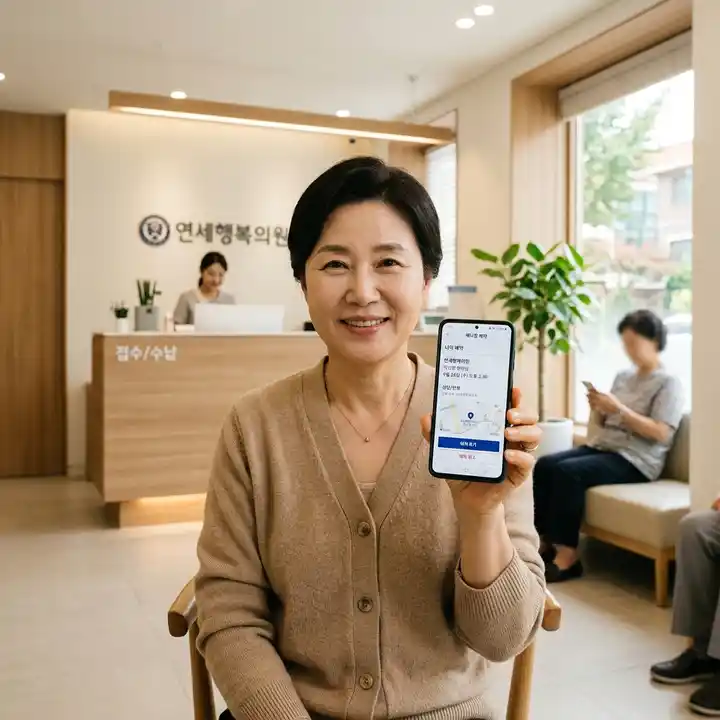
- Before leaving for work, I opened a mobile booking app, selected our neighborhood clinic, and booked an open morning time slot.
- Arriving at the third-floor clinic, I verified my identity with a mobile credential and waited briefly in the lounge.
- Consulting my long-time physician and picking up packaged pills from the first-floor pharmacy took under twenty minutes from door to door.
- In Korean cities, commercial plazas typically host medical clinics on the second through fifth floors with a pharmacy on the ground floor.
To give international readers a clear look, here is the exact chronological sequence of my clinical visit and prescription pickup this morning.
Just like clockwork, the seasonal cold flared up, making it painful even to swallow.
At 8:45 AM while getting ready for work, I pulled out my phone and opened our neighborhood clinic booking app.
I selected the ENT clinic on the third floor of the commercial plaza just a five-minute walk away, confirmed an available morning slot, and finished the reservation.
Since May 20, 2024, Korea strictly enforces mandatory in-person identity verification at all medical facilities. Patients must present a physical resident registration card, driver's license, passport, or a verified mobile ID on their smartphone. Disability cards and alien registration cards are also officially accepted.
Upon arrival, I verified my identity at the reception kiosk, received my printed queue ticket, and watched my name appear on the waiting room monitor with the middle syllable masked for privacy.
After a brief wait, a nurse called my name.
Inside the exam room, the board-certified specialist who has examined my throat for over a decade reviewed my digital chart, asked detailed questions about when the pain began, and wrote the prescription.
At the payment desk, paying with my debit card settled the national health insurance co-pay of 5,800 won.
Carrying the paper prescription, I took the elevator downstairs to the ground-floor pharmacy. Handing the slip to the pharmacist, I waited only a moment before receiving my packaged medication. After listening to familiar instructions on taking the pills after meals, I paid 4,200 won and headed straight to the subway station.
From the moment I left my front door to slipping the pills into my bag at the subway turnstile, the entire trip took under twenty minutes.
3. The Unseen Power of Neighborhood Buildings Packed with Specialists
- Commercial plazas throughout residential districts cluster board-certified specialists floor by floor within easy walking distance.
- The single-payer National Health Insurance Service and rapid digital networks eliminate bureaucratic paperwork and advance deposits.
The real secret behind slipping into shoes and finishing a specialist visit in under twenty minutes lies in the unique architecture of our neighborhood shopping plazas.
Taking a look at the elevator directory of almost any commercial building in an apartment neighborhood tells a revealing story.
The second floor holds an internal medicine clinic, the third floor houses an ENT and pediatrics office, the fourth floor hosts orthopedics and dentistry, and the fifth floor features ophthalmology.
Physicians who completed demanding internships and residencies at university hospitals choose to open private practices right in residential shopping centers, competing intensely for local patients.
This concentration is backed by the nationwide National Health Insurance data network.
Showing a national identity credential or a smartphone mobile card verifies insurance eligibility and treatment history within seconds at any medical office across the country.
The moment the doctor signs the prescription on his monitor, the Drug Utilization Review network operated by the state review agency checks for dangerous drug interactions in real time.
Korea operates the Health Insurance Review and Assessment Service (HIRA). When medical clinics submit claims for treatment, HIRA stands in the middle to rigorously inspect and evaluate whether every billed procedure was clinically necessary before the National Health Insurance Service releases public funds.
4. The Uneasy Shadows Behind Our Speed and Worry for My Parents
- The morning rush to secure pediatric and popular clinic appointments through smartphone apps can feel exhausting.
- Watching elderly parents in their seventies get turned away at clinic counters because app slots filled up leaves a heavy feeling.
- Brief three-to-five-minute consultation windows place constant operational strain on physicians, fueling wider medical shortages.
Living inside this system every day, however, makes it impossible to ignore the uncomfortable realities trailing behind this extraordinary convenience.
Raising my own children, I have gripped my phone in the morning with sweating palms, frantically tapping the screen to secure an appointment at the local pediatrician.
The feeling cuts even deeper when I speak with my parents in their seventies back in my hometown.
My mother once walked to a local clinic early in the morning with her cane because her knee was aching, only to be told that all morning slots were already taken by younger people booking on their smartphones. Hearing her voice over the phone as she walked back home empty-handed left me with a heavy sense of guilt. Ever since that day, I remotely book hospital appointments for my parents in the countryside directly from my own smartphone in Seoul.
As the world speeds up, the barrier to medical care has quietly risen for older generations who cannot navigate mobile apps.
Furthermore, sustaining rapid visits relies on doctors seeing patients in brisk three-to-five-minute intervals. This high-volume environment pushes dedicated physicians toward chronic exhaustion and discourages medical graduates from entering labor-intensive essential specialties.
The twenty-minute convenience we rely on each morning is an impressive technological achievement, but it balances on the relentless labor of medical staff and the quiet exclusion of vulnerable neighbors.
Recognizing the unseen costs behind this speed is the only way to truly understand the real life of modern Korean healthcare.
Practical Guide to Korean Neighborhood Clinics & Pharmacies for Tourists
Don't panic if you suddenly fall ill during your trip. Here are some practical tips for foreign tourists to easily use Korea's fast and comfortable medical system.
- Tourists Can Visit Neighborhood Clinics (Passport Required): If you catch a cold or have a mild stomachache, there is no need to visit a large university hospital emergency room. You can visit a neighborhood clinic (internal medicine, ENT, etc.) located on the 2nd or 3rd floor of commercial buildings. However, you must bring your original passport for identity verification.
- Medical Costs for Uninsured Tourists: Foreign tourists without Korean National Health Insurance must pay 100% of the medical expenses out-of-pocket. However, the cost is surprisingly affordable; a simple consultation usually costs around 20,000 to 30,000 KRW, and credit cards are widely accepted.
- Doctors and Pharmacists are Separated: After your consultation, the clinic will not give you medicine directly but will only provide a paper 'prescription'. You must take this prescription to a 'Pharmacy (Yakguk)', usually marked with a green cross on the 1st floor, to get your medication.
- Actively Use Translation Apps (Papago): Not every doctor or pharmacist at a neighborhood clinic speaks perfect English. If you write down your symptoms in advance (e.g., "I have a sore throat and fever", "Please give me non-drowsy medicine") on a translation app like Papago and show it to them, you can fully experience Korea's ultra-fast 20-minute medical service.
- When You Need Urgent Medical Interpretation: If communication is completely impossible or you suddenly fall ill at night, call 1330, the 24-hour tourist interpretation hotline. They can connect you to the 119 emergency center or assist with medical interpretation if needed.
Food as Comfort: The Deep Meaning of Sharing Meals & Drinking in K-Dramas
Explore why asking 'Have you eaten?' is the ultimate expression of love and healing in Korean culture.
📌 Recommended Related Posts
이 리뷰를 한국어로 읽고 싶으신가요?
🇰🇷 한국어 리뷰 읽기