Korea's 24-Hour Convenience Stores: How They Became a Nighttime Safety Net
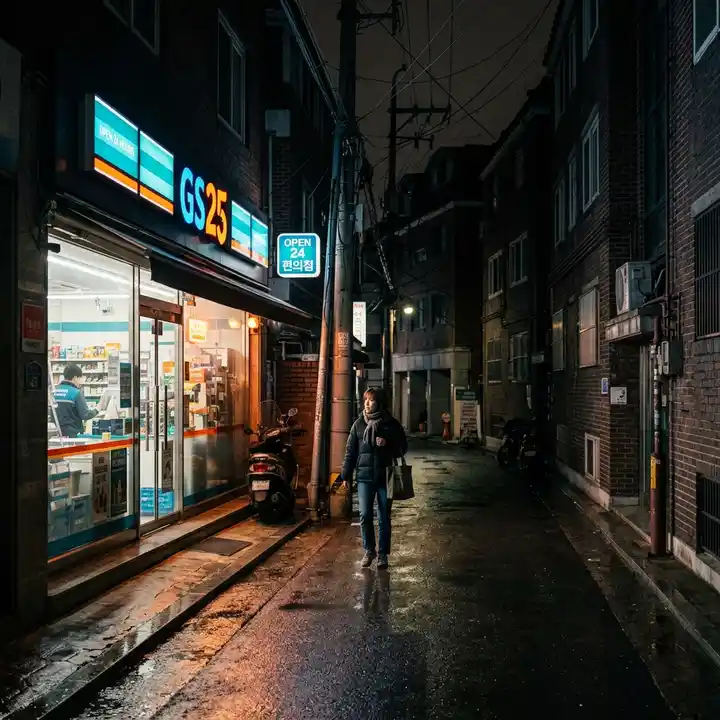
Stepping out of a quiet subway station into a residential alley past 1 a.m. in a Korean city reveals a distinctive urban landscape. While residential windows are dark and small shops have long lowered their steel shutters, a single bright beacon remains illuminated at the corner. That glow belongs to a 24-hour convenience store. When my son returned late from his cram school, he would often stop by to grab a warm cup of instant ramen, and I still pick up a canned coffee on my walk home from overtime. Whenever we head out to meet our children late at night, the natural instruction is always, "Let's meet in front of the convenience store." Beyond food and drink, these stores provide critical health relief: under Korea's legally designated Over-the-Counter (OTC) medicine system introduced in 2012, residents can purchase digestive pills, headache medication, cold remedies, and pain-relief patches even when local pharmacies are closed for the night. The 24-hour store is not merely a retail outlet, but an indispensable safety anchor woven into the fabric of daily Korean life.
High-Lumen Beacons and the Natural Surveillance Grid
- High-lumen LED lighting and floor-to-ceiling glass fronts illuminating alleyways
- A dense network spaced on average 200 to 300 meters apart in residential zones
- Natural surveillance combining staffed counters, customers, and active recording
The physical layout of Korean convenience stores makes them an organic fit for urban safety. Most stores are built with clear floor-to-ceiling glass facades and powerful white interior illumination that spills out onto the pavement. In residential districts where streetlamps can be sparse or dim, the illuminated perimeter around a convenience store creates an immediate pocket of high visibility.
In urban planning and criminology, this reflects the principle of natural surveillance under Crime Prevention Through Environmental Design (CPTED). Deterrence relies heavily on the constant perception that a space is visible and occupied. With clerks on duty, late-night shoppers frequently stepping in, and multiple security cameras monitoring both the register and the entrance, a convenience store functions as an active neighborhood watchtower.
Because Korean urban areas feature branches every 200 to 300 meters, pedestrians walking through dark alleys know that help and light are never more than a two-minute walk away. Furthermore, this retail grid operates alongside frequent police cruiser patrols, neighborhood civilian watch groups (자율방범대), and municipality-operated surveillance cameras, creating one of the most comprehensive nighttime safety ecosystems in the world.
Direct 112 Police Hotlines and Emergency Safe Havens
- Official designation as Women's Safe Havens in partnership with the National Police Agency
- One-touch emergency alarm buttons beneath counters alerting local police consoles immediately
- Physical shelter capabilities designed to protect pedestrians facing immediate danger
The nighttime safety role of Korean convenience stores is reinforced by formal institutional integration. Since the mid-2010s, major convenience store operators have partnered with the National Police Agency and local municipal governments to designate thousands of branches as official emergency shelters, widely known as Women's Safe Havens.
If a pedestrian feels followed or encounters a threat on the street, they can run directly into the store. Cashiers are trained to activate emergency panic buttons installed beneath the counter or use specialized off-hook phone reporting systems. Pressing the button instantly transmits the store's exact geographic coordinates to the local 112 police dispatch system, triggering an immediate priority response from nearby patrol vehicles.
Certain locations also feature remote magnetic door-locking mechanisms that allow staff to secure the entrance from inside, keeping an aggressor out while shielding the victim until police officers arrive. This direct synthesis between private retail branches and public emergency services provides an immediate physical refuge that few other commercial establishments offer.
Psychological Anchor for Solo Dwellers and Night Commuters
- An essential buffer zone for solo households walking home through quiet neighborhood lanes
- Shared presence between night-shift workers and commuters mitigating urban isolation
- Quiet reassurance created by accessible human presence during the quietest hours
For residents living in studio apartment districts or quiet residential quarters, convenience stores serve as a vital psychological buffer. Returning home after midnight on the last bus can feel isolating, but the familiar signage at the alley entrance signals that one has reached a protected sphere.
Parents waiting for teenagers returning late from school or library sessions often designate the local convenience store as the meeting point. For solo women and late-night workers, stepping inside to pick up a warm drink or simple groceries offers a brief moment to decompress in a well-lit, staffed environment before covering the final stretch home.
The interaction between the graveyard-shift cashier and the late-night patron is typically brief and quiet. Yet, the simple presence of another human being awake and alert at 3 a.m. provides tangible reassurance. The mutual recognition between night worker and night commuter forms an unspoken social bond that stabilizes the street.
Shifting Operation Models and the Future of Night Safety
- The growth of unstaffed hybrid branches and shortened overnight hours
- The irreplaceable role of on-site personnel during genuine physical emergencies
- The need to balance private commercial shifts with sustained public alley security
In recent years, rising operational costs and changing demographic patterns have led some convenience store branches to reconsider 24-hour operation. Certain stores now close between midnight and dawn, while others transition to unstaffed self-checkout systems during nighttime hours.
While unstaffed locations keep their lights and automated cameras operational, the absence of an on-site worker changes the dynamic for street safety. An automated kiosk cannot assess a dangerous situation outside, lock a door to protect a resident, or speak calmly to someone who has rushed inside in distress. The human presence behind the counter has always been the linchpin of the emergency response.
For decades, Korean urban society has leaned comfortably on the private convenience store network to supplement public street safety. As operating models evolve toward shortened hours and automation, maintaining that vital blanket of nighttime protection will require deliberate coordination between urban planners, municipal safety initiatives, and local communities.
Notice: This content was created by combining the review of a professional editor with AI research assistance technology.
Practical Guide to Korea's 24-Hour Convenience Stores for Tourists
Korea's convenience stores (CU, GS25, 7-Eleven, emart24) are not just shops; they are reliable basecamps for late-night travel. Here are some practical tips every tourist should know:
- Take Refuge Whenever in Danger: If you feel threatened or get lost while walking late at night, head straight inside a brightly lit convenience store. All Korean convenience stores serve as 'Safety Guardian Houses' equipped with an emergency bell system directly connected to the police (112).
- Buying Late-Night Emergency Medicine: If you suddenly fall ill at night or on a public holiday when pharmacies are closed, go to a convenience store. They sell essential 'Over-the-Counter (OTC) household medicines' such as fever/pain relievers (Tylenol), cold medicine (Pancol-A), digestive aids, and pain-relief patches. These are usually kept behind the counter, so just ask the staff for help. (Note: Purchases are limited to one box per person.)
- T-money Recharge and Card Payments: Convenience stores are the most reliable places to buy and recharge your transit card (T-money). Additionally, even if you don't have cash, you can pay for any item, regardless of the amount, using an international credit card.
- Check for 1+1 and 2+1 Discount Signs: If you see a '1+1' (buy one, get one free) or '2+1' sign on the price tag, don't miss out! It's a fun shopping culture unique to Korean convenience stores that allows you to buy drinks and snacks at a much lower price.
- Use Them as Late-Night Diners (Eat-in): Most convenience stores are equipped with hot water dispensers, microwaves, and tables where you can sit and eat. It's the best place to safely and cheaply enjoy instant ramen or a dosirak (bento box) when you're hungry late at night.
Food as Comfort: The Deep Meaning of Sharing Meals & Drinking in K-Dramas
Explore why asking 'Have you eaten?' is the ultimate expression of love and healing in Korean culture.
📌 Recommended Related Posts
이 리뷰를 한국어로 읽고 싶으신가요?
🇰🇷 한국어 리뷰 읽기