Coupang Rocket Delivery Guide: How 7 AM Dawn Shipping Works
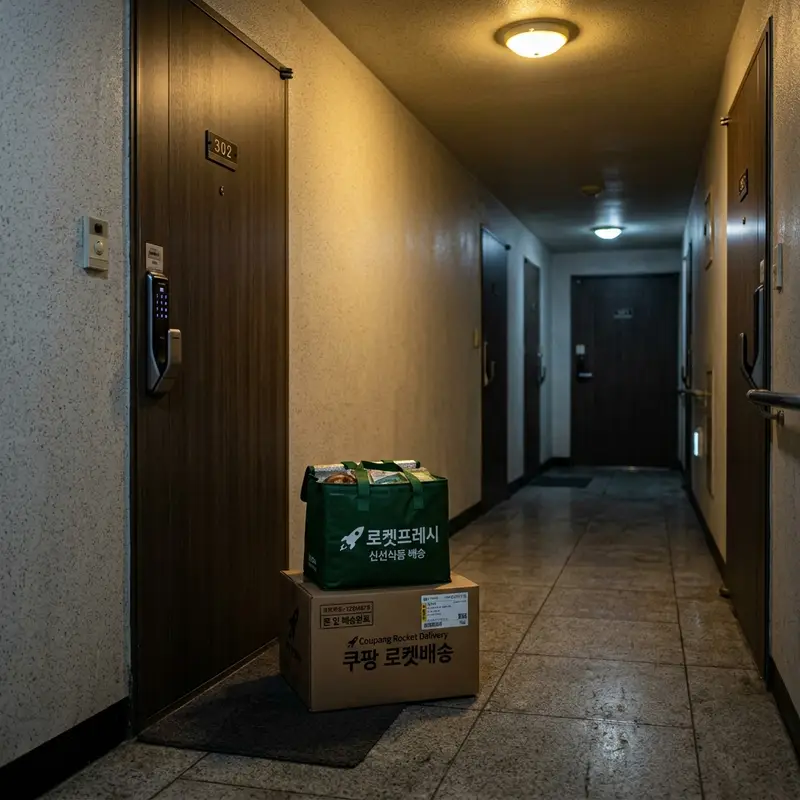
Practical Guide to Korean Delivery Culture for Tourists
If you want to personally experience Korea's fast delivery speed, be sure to check out these three tips!
- Limitations of Using Coupang for Tourists: According to Coupang's official privacy documentation, Coupang and Coupang Pay collect mobile phone numbers and information on Korean and foreign members during the identity verification process, and in some cases may require verified real-name information such as a foreigner registration number. Because of this, short-term visitors often find Coupang inconvenient to use. If you truly need something, asking a Korean friend or using a proxy shopping service is a practical alternative.
- Hotel Delivery Tips: You can certainly order online shopping or food delivery to a hotel. However, it is polite to ask the hotel front desk in advance if they can receive packages or food on your behalf. Additionally, to prevent any confusion for the delivery driver, you must use Naver Map to copy and paste the exact Korean address into the delivery app.
- Foreigner-Friendly Delivery App (Shuttle Delivery): Korea's representative delivery app, Baedal Minjok (Baemin), now supports English and accepts international credit cards and Apple Pay, making it convenient to use. However, if you prefer paying with PayPal or want a fully Western-style service, we recommend the Shuttle Delivery app. You can sign up without a Korean phone number, and their customer service communicates in English, making it highly tourist-friendly. (Note: Unlike Baemin, Shuttle Delivery primarily operates in parts of Seoul, and around US military bases or major cities like Pyeongtaek, Daegu, and Busan, so be sure to check if they deliver to your area before using it.)
If you were to pick one app that is indispensable in the daily lives of modern Koreans, it would undoubtedly be a shopping delivery app. In particular, 'Dawn Delivery' and 'Rocket Delivery'—powered by a densely woven logistics infrastructure—have combined well with Korea's unique 'Ppalli-Ppalli' (hurry up) sentiment to greatly change our lifestyle. Recently, I had an experience that made me marvel once again at this mind-boggling delivery speed.
Ordered at 2 PM, Arrived at 10 PM: A Real Experience
I had to go hiking early the next morning with some friends, but I only realized around 2 PM on the weekend that I had completely forgotten to buy chocolate bars, water, and simple snacks to eat on the mountain. Too lazy to go outside right away, I opened the Coupang app as usual, put the snacks in my digital cart, and checked out. I thought to myself, 'Well, it's Dawn Delivery which guarantees arrival before 7 AM tomorrow anyway, so it'll be perfect if I just pack my bag right after waking up.'
However, around 10 PM that night, while I was watching television in the living room, I heard a "thump" outside my front door as a box was set down. Half in disbelief, I opened the door, and there, sitting quietly on my doorstep, was the snack box that must have been in a fulfillment center just hours prior. At that exact moment, my smartphone buzzed with a friendly text message saying, "Your delivery has been completed," along with a photographic proof of the box sitting safely at my door. Thanks to this well-organized system—which covers everything from package pickup and real-time tracking to a secure delivery confirmation photo—I can go to sleep peacefully, knowing that everything is set for tomorrow's hike. While this is made possible by Coupang building massive logistics centers tightly across every region, witnessing an item ordered in the afternoon arriving with a photo text message before the day is even over is a remarkable sight that still amazes me, even after living in Seoul for over 20 years.
The Secret of Local Marts' 1-Hour Delivery and Mega-Mart Regulations
When you experience such an overwhelming delivery culture, you realize an interesting fact. South Korea has a small landmass and a high population density, which means that even outside of dedicated e-commerce giants, there are places with massive delivery potential. These are the supermarkets right in front of your home: small neighborhood marts, traditional markets, and the large offline chains such as E-mart, Homeplus, and Lotte Mart.
In fact, Korea has a remarkably well-built hyper-local ecosystem in which ordering from a small neighborhood mart by phone or app brings groceries to your doorstep by one-ton truck or scooter in as little as one hour, and usually within about three hours.
One day I did my grocery shopping at a neighborhood mart, asked them to deliver it, and walked home slowly for the exercise. I assumed that even delivery by car would take a little while. But by the time I got home, the delivery driver had already dropped the bags off. Not even thirty minutes had passed since I placed the order, which honestly startled me.
The system that restricts the business hours and mandatory closure days of large supermarkets was created to maintain a healthy distribution order, to protect the health rights of workers, and to promote the co-development of large retailers and small and medium-sized distributors. Even today, the specific limits on business hours and mandatory closure days are applied through local government ordinances based on national law.
Of course, this system remains the subject of an ongoing debate over how to balance the competitive environment between large distributors and traditional markets and small business owners. In particular, as online shopping and dawn and same-day delivery have grown rapidly, the question of regulatory fairness between existing offline retailers and online retailers is being discussed alongside it.
This was a deeply human choice: running at the very front line of the fastest and most efficient capitalism, while willingly accepting the inconvenience of regulation in order to grow together with the vulnerable. Yet today, as online retailers sitting in a regulatory blind spot come to dominate the distribution market, we face the ironic reality that this beautiful mechanism of coexistence is producing a different kind of inequality, one that discriminates against offline marts.
A Strange Sense of Relief in the Fastest Country
Korea is a country where whatever you need magically appears at your door, day or night, with a single click. Every day I turn on delivery apps and fully enjoy the benefits of this dazzlingly convenient infrastructure, but there are times when this overwhelming speed almost makes me dizzy.
However, when I remember that even amidst this terrifying race for speed, there are minimum safety nets (laws) in place so that market vendors and small business owners can survive together, I feel a strange sense of relief—a realization that the system isn't just a cold, heartless capitalist machine. As I pack the snacks into my hiking backpack for tomorrow morning, I find myself once again feeling deeply thankful for the delivery drivers who sweat day and night in unseen places to make this incredible miracle possible.
📌 Recommended Posts
이 리뷰를 한국어로 읽고 싶으신가요?
🇰🇷 한국어 리뷰 읽기