5 Taxi Mistakes Foreigners Make in Korea (Avoid Overcharging)
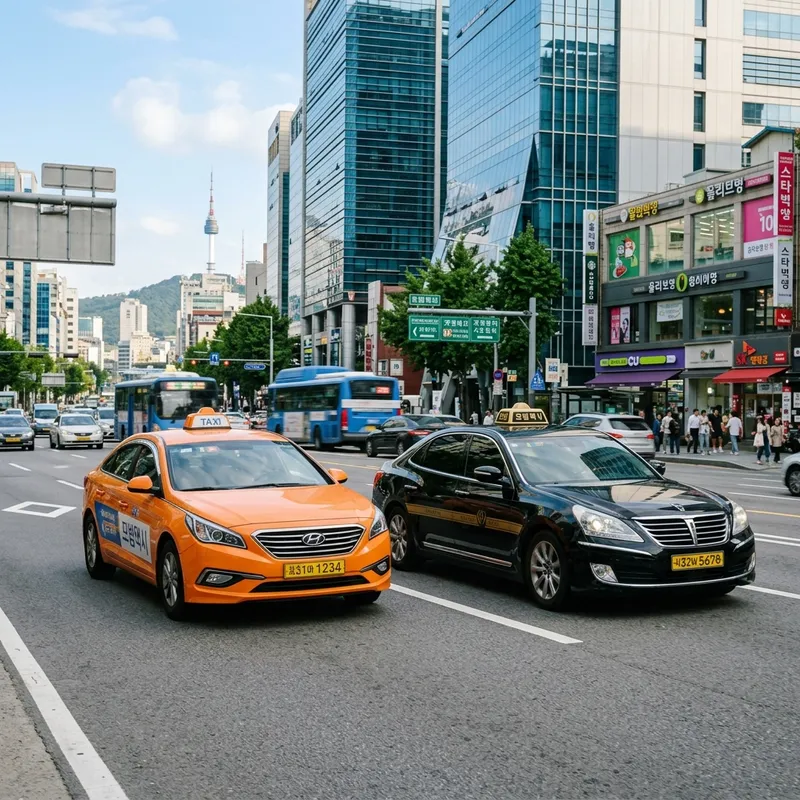
Practical Guide to Taking Taxis in Korea
Taxis in Korea are safe and honest, but misunderstanding car colors and dashboard lights can lead to unexpected higher fares or hailing difficulties. Keep these practical tips in mind for a hassle-free trip.
- Check Taxi Colors for Fares: Orange, white, and silver cars are standard mid-sized taxis with lower base fares. Black cars with yellow roof signs are Deluxe (Mobeom) Taxis with higher rates.
- Look for Red 'Vacant' Lights: A red illuminated sign (빈차) on the front passenger dashboard means the taxi is vacant and available. Blue or yellow lights (예약) mean the vehicle is reserved.
- Politely Decline Airport Touts: Ignore touts approaching you inside airport terminals offering flat rates; head straight to the official taxi stand outside.
- Use Kakao T On-Site Card Payment: If you cannot register an international credit card on the Kakao T app, choose 'Pay directly to driver' (현장 결제) to pay with your card at the driver's terminal.
- Verify the Meter & Ask for a Receipt: Ensure the meter is turned on at departure and keep your paper receipt upon arrival—it contains driver contact info in case you leave belongings behind.
Fare Differences Caused by Taxi Colors
In Korea, taxi types and base fares vary depending on the color of the vehicle. The orange (Haechi taxi), white, and silver vehicles most commonly seen in Seoul and the metropolitan area are standard mid-sized taxis. They offer the lowest base fare and are standard taxis that can be used anywhere without burden. On the other hand, vehicles with a luxurious black exterior accompanied by yellow stripes or a 'Model Taxi (모범)' sign are Deluxe Taxis (Mobeom Taxi).
I still vividly remember the day in 1997 when I first arrived from the countryside at Gangnam Terminal in Seoul. I wasn't familiar with public transit, so my relative told me that taking a taxi would get me there comfortably. Without giving it much thought, I got into the first taxi that pulled up in front of me. When I arrived at my relative's house and saw the fare, I was completely shocked. It came to 18,000 KRW. A standard taxi would have cost around 5,000 KRW for that distance, but without knowing, I had gotten into a Deluxe Taxi. Ever since then, I have made a habit of checking the car's color before getting in.
Korea's Deluxe Taxis were first introduced in December 1992. It was a policy system introduced by the government to upgrade taxi service quality and achieve modernization, featured by distinct black car bodies, yellow roof caps, and installed receipt printers. Initially, licenses were granted primarily to veteran private taxi drivers with more than 10 years of accident-free driving experience, aiming to provide high-quality service without ride refusals in exchange for higher fares than standard taxis.
Recently, large and premium call-only taxis such as Venti or i.IM in the form of black or white large vans have also increased. If you are a first-time overseas traveler to Korea, it is best to check the vehicle type and color before boarding.
Confusing 'Vacant' and 'Reserved' Indicator Lights
When hailing a taxi on the street, check the illuminated display on the right side of the front windshield and board if it indicates 'Vacant (빈차)'. Because of the red lettering, it is easy to mistake it as a signal not to stop, but the red light must actually be ON for you to board. Conversely, if 'Reserved (예약)' is lit up in blue or yellow light, the vehicle is on its way to pick up a passenger who has already hailed it via an app.
A reserved taxi will not stop even if you wave your hand, so be sure to check for the red 'Vacant' light on the front windshield. This is the part that confuses first-time visitors the most, so it helps to get into the habit of double-checking the light color whenever you hail a taxi at night.
Beware of Illegal Soliciting Vehicles at Airports or Tourist Areas
In areas with many tourists such as Incheon International Airport, Myeongdong, and Gangnam Station, people may approach you near entrances or taxi stands asking "Taxi?". Official Korean taxi drivers never step out of their vehicles to solicit passengers. They line up at designated stops or wait at official taxi stands with their meters running.
If you follow solicitors and board private vans or illegal vehicles without official meters, there is a high risk of being overcharged several times the standard rate. Always use official taxi stands or ride-hailing apps. If a stranger approaches you first and asks for your destination, it is safer to simply ignore them and head to the official taxi stand.
Giving Up on Kakao T App Payment and Missing Rides
The most useful app for calling a taxi in Korea is Kakao T. Foreign tourists often give up using the app, assuming overseas credit cards cannot be registered. However, if you select 'Pay directly to driver' as the payment method when calling, you can freely hail a taxi without registering a credit card in the app.
When you set your destination in the app and call, the destination is automatically sent to the driver in Korean, allowing you to travel safely without language barriers. Upon arrival, you can pay the driver directly using cash, overseas credit cards, or T-money transit cards at the terminal. Using a prepaid card with transit features helps prevent potential risks during payment.
Checking the Meter at Departure and Getting a Receipt
The use of taximeters is legally mandated for all official taxis in Korea, and the system is highly transparent. When you get into the car, check that the meter light turns on and starts from the base fare. Occasionally, drivers may forget to press the meter at departure, so it is good practice to visually verify that the meter is running right after starting.
After completing payment upon arrival, always request and keep a receipt. The receipt specifies the taxi license plate number, driver's contact info, usage time, and traveled distance. This makes it easy to retrieve lost items and serves as clear evidence in case of fare disputes.
📌 Recommended Posts
이 리뷰를 한국어로 읽고 싶으신가요?
🇰🇷 한국어 리뷰 읽기