Korean PC Bang Guide: How Foreigners Can Log In, Play & Order Food
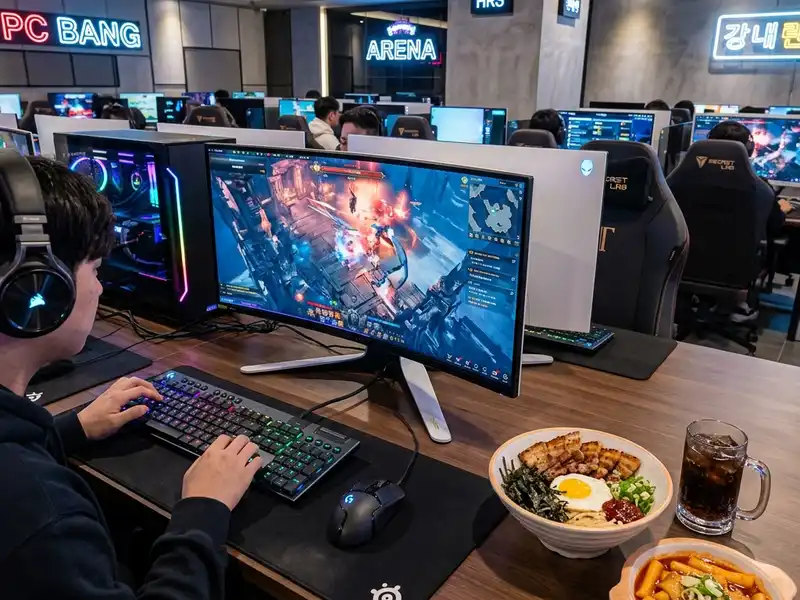
Practical Guide to Korean PC Bangs for Tourists
Korean PC Bangs are a distinctive cultural space where you can enjoy gaming and food at the same time. Here are some practical tips for tourists:
- How Foreigners Log In (Non-member Access): Creating an account at a Korean PC Bang usually requires a Korean phone number or Resident Registration Number. Tourists should use the kiosk near the entrance and press the 'Bi-hoewon (Non-member)' button. Pay for your desired time with cash or a card, and use the temporary number printed on the receipt to log into the PC at an empty seat.
- Game Account Issues: It is difficult for foreigners to sign up for Korean server online games (like League of Legends) because they require a Korean ID verification. Instead, we recommend logging in to your global accounts (Steam, Epic Games, etc.) to play, or enjoying Netflix or YouTube on the ultra-high-speed internet. (Don't forget to log out of your personal accounts before you leave.)
- Order and Pre-pay Directly from Your Seat: There's no need to go to the counter. Use the 'Order Food' menu located at the top of the PC monitor screen. Nowadays, Korean PC Bangs use a pre-payment system where you pay immediately on the screen upon ordering. If you select credit card, a payment window will pop up on the screen, or you can insert your card directly into the wireless card reader attached to your seat. (Only if you select 'Cash Payment' will the staff come to collect the money when they bring the food, or you may have to go to the counter yourself to pay in cash.)
These days, on weekends, my son always rushes out to the local PC Bang (internet cafe) to meet his friends. He plays high-spec games and even has his lunch sorted out right there. Thinking about him staring at the screen for hours brings a smile to my face, because it overlaps perfectly with my own youth about 30 years ago.
When I was a student in the late 90s, the PC Bangs that first appeared in our neighborhood were quite different from today. They were usually in dark basements, filled with cigarette smoke, where my friends and I would pull our chairs close to CRT monitors and play Starcraft, Tetris, or Galaga all night long. The sound of clacking keyboards mixed with the smell of instant cup noodles made it the ultimate hideout for our generation. However, over the past 30 years, the Korean PC Bang has evolved into a completely different dimension.
A High-Spec Space Serving Pork Belly Rice Bowls
The PC Bang my son treats as his second home is fundamentally different from a garage-style LAN party or a dark alleyway game shop in the West. When you push open the glass doors, you are greeted by bright, clean lighting and spotless tiled floors. Across the room, hundreds of high-spec computers are lined up in rows. They are equipped with ultra-high-speed wired internet that is hard to match at home. High-refresh-rate monitors, mechanical keyboards, and dedicated gaming mice are standard at every seat.
But a more dramatic change than the computer specs is the food culture. When I was young, pouring hot water into a cup noodle at the front counter or microwaving a hot dog was the limit. Now, as you lean back in a plush executive chair, a single mouse click on the monitor's digital menu delivers dishes that rival an actual restaurant. The options number in the dozens: pork belly rice bowls full of smoky flavor, sweet and spicy tteokbokki topped with fried snacks, handmade burgers with freshly grilled patties, and liter-sized iced Americanos.
Thanks to the convenience of eating, drinking, and continuing to game without having to visit a separate restaurant, my son spends his entire weekend afternoon there without worrying about meals. When I take foreign friends or business clients to see a PC Bang, this is the part that surprises them the most. They are amazed by this unique system where you can enjoy high-end gaming and a variety of food at the exact same time without leaving your seat.
A Safe Playground and Hideout Even Parents Trust
Naturally, as a parent, your first instinct is to worry when your child says they are going out just to play games. Paradoxically, however, today's PC Bang has become one of the brightest and safest playgrounds in the neighborhood. The entire indoor area is strictly managed as a non-smoking zone, so the stale odors of the past are long gone. Some PC Bangs even operate a separate smoking room. Furthermore, CCTV is installed everywhere, and there are time slots at night when minors are restricted from entering.
On weekend afternoons, kids gather in groups, sit side by side, and enjoy team play over voice chat. The process of strategizing together, cheering for a victory, and sharing the disappointment of a loss is not much different from how my generation used to sweat while playing soccer in neighborhood empty lots or alleyways. The stage has simply moved from an offline field to online games inside a fully equipped, high-tech PC Bang.
Sometimes, as a parent, it is oddly reassuring to know they are hanging out with friends in an air-conditioned PC Bang where their meals and snacks are prepared hygienically, rather than wandering around outside. Occasionally, I sit next to my son to show off my old gaming skills, only to realize that I am no match for his flashy hand movements and fast reflexes. At those times, ordering a cold coffee from my seat and watching my son play becomes quite an enjoyable weekend pastime for me.
The State-Led Infrastructure Sparked by Starcraft
So how did the Korean PC Bang evolve beyond a simple arcade into such a massive cultural infrastructure? The answer lies in the 'Starcraft craze' that swept South Korea in the early 2000s and the rapid, state-level infrastructure investments that supported it.
When I was in my energetic twenties, turning on the television at night meant watching live broadcasts of professional Starcraft players on dedicated game channels like OGN, rather than regular sports networks. It was the moment when gaming, previously dismissed as "just a toy for kids," transformed into a genuine 'sport,' complete with flashy lighting, passionate commentators, and tens of thousands of fans packed into massive stadiums.
In 2000, with the launch of KeSPA (Korea e-Sports Association), the institutionalization and professionalization of e-sports began in earnest. Neighborhood youths who used to grip their mice while eating cup noodles suddenly held the official job title of 'Professional Gamer,' and large conglomerates rushed to found pro gaming teams. Coupled with the nationwide rollout of ultra-high-speed internet, gaming matches were broadcast across the entire country every single day.
Ultimately, thanks to swift institutional support and a strong broadcasting infrastructure established early on, Korea developed an e-sports culture with global influence. I, who stayed up all night cheering in a dark PC Bang 30 years ago, am now a middle-aged father in my fifties. My son is carrying on that exact cultural legacy, enjoying a pork belly rice bowl in a much brighter, more advanced space. I believe this is the true strength of Korean PC Bangs and e-sports—a culture that continuously evolves and connects generations.
📌 Recommended Posts
이 리뷰를 한국어로 읽고 싶으신가요?
🇰🇷 한국어 리뷰 읽기