How to Use a Korean Noraebang: Remote Buttons, Coin Rooms & Prices

Practical Guide to Korean Noraebang for Foreign Visitors
- Don't panic at the Korean remote: The screen may have an English button, but many remotes do not. The three buttons to find first are 한/영 (Korean/English input toggle), 제목 (title), and 가수 (artist).
- Reserve and Start are different: 예약 (Reserve) adds a song to the queue. 시작 (Start) plays a song immediately. 취소 (Cancel) deletes a song from the queue, so pressing it at the wrong moment can wipe someone else's pick.
- Payment varies by coin noraebang: Songs usually cost around ₩500 each, or ₩3,000–5,000 for 30 minutes. Some venues ask you to choose a room and plan at an entrance kiosk; others let you enter an empty room and pay at the machine. Check the instructions at the venue.
- Standard noraebang charges by the hour: ₩15,000–30,000 per hour for the room, not per person. Split among four people, that is about ₩3,750–7,500 each for an hour. You normally pay at the desk first.
- Extra time is not an extra charge: In a standard noraebang, the timer often jumps by 10–20 minutes near the end. This is service, a free extension, not a fee.
- Use a mic cover: Many rooms provide disposable covers. Ask staff if you do not see any.
- Check the business type on the sign: 노래연습장 is a regular noraebang. If the sign shows 단란주점, 유흥주점, or terms such as "helper" or "hostess," it is a different type of business.
What This Guide Covers
- Getting to Know the Korean Remote
- Searching for a Song and Queuing It, Step by Step
- Coin Noraebang vs Standard Noraebang
- How to Use the Coin Noraebang Payment Machine
- What "Service" Time Really Means
- Room Etiquette Worth Knowing
- How to Choose a Safe Noraebang
For a while, heading to a noraebang for the second round after a work dinner was common. I still remember going with my coworkers. As we moved on in small groups after finishing the first round (1-cha), our team leader pointed to a noraebang sign with a familiar wave. My coworkers kept saying, "I can't sing," but we all ended up walking up the stairs together. Inside, my coworkers picked songs on the remote while I brought back drinks and snacks to share, and we all sang loudly together to blow off steam. The sound system and echo were basic compared with what you find now, but I remember having a great time. Even today, when I go to a noraebang, I mostly sing the newest tracks, but I still find myself singing those old favorites while reminiscing about those days.
In Korea, a noraebang is not a place you visit only on special occasions. It is where a work dinner ends, where birthdays happen, where people go after exams, or where friends and families often gather. These days, with coin noraebangs where you can walk in alone without any pressure, people visit even more often.
Getting to Know the Korean Remote
Inside the room you will find a large screen, two microphones, a tambourine, and a remote. More rooms now have a tablet as well, but plenty of places still keep a remote and a songbook. The catch is that even when the screen has an English button, many remotes have no English labels at all. When you first pick one up, the dozens of buttons make it hard to know where to start.
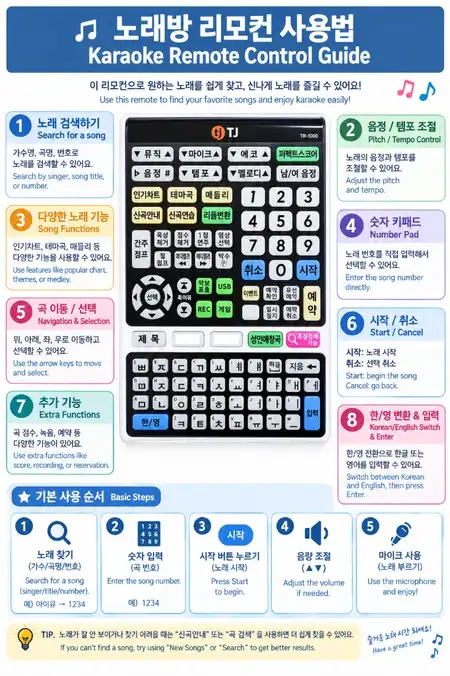
Fortunately, the Korean labels on remotes are broadly similar from one venue to another. Learn a few buttons you will use often, and you can search for and queue songs without knowing the rest.
- Basic Search:
한/영(Language Switch),제목(Title Search),가수(Artist Search),팝송(Pop Song Search; availability varies by machine) - Key & Tempo:
남/여음정or키♭/키♯(Male/Female Key & Pitch Adjust; labels vary by machine),리듬변환(Tempo Control) - Convenience:
간주점프(Skip Interlude),점수제거(Remove Score Screen),녹음(Recording; availability varies by machine)
If a song is too high for your pitch, try pressing 남/여음정 or 키♭/키♯ to adjust the key. If you want to skip the awkward score evaluation at the end of a song, press 점수제거 in advance.
Recording on Some Machines
Some karaoke machines offer a recording function. Support and the available save or transfer methods vary by machine and venue, so check the on-screen instructions before starting.
- Email or app transfer: On machines that support it, follow the on-screen instructions to enter an email address or connect a compatible app. NFC or Bluetooth pairing and transfer steps vary by machine and app.
- USB storage: If the machine supports USB saving, connect a drive to the indicated port and follow the on-screen instructions. File format and save steps may vary.
- Note: If no recording or transfer option appears, the machine may not support it. Follow the on-screen instructions or ask a staff member.
Searching for a Song and Queuing It, Step by Step
The most confusing point is the difference between Reserve and Start. The two buttons look alike and have short names, so it is easy to assume they do the same thing. They do not.
Reserve adds a song to the queue so it plays after the current one finishes. In practice, requesting a song at a noraebang usually means pressing this button. Start, by contrast, plays a song immediately, regardless of the queue. If the room is quiet and you want to start the first song right away, press Start. If a song is already playing and you want to line up the next one, press Reserve.
This is where mistakes happen. Cancel deletes a song from the queue. You press it to remove your own pick, and the song someone just queued disappears instead. To avoid this, press Reserve Check first to see the queue on screen, confirm which song is yours, and then press Cancel. If you need to move a song up, Priority Reserve bumps it to the next slot.
The search order works like this. Press 한/영 to switch to English input. Press 제목 or 가수 and type your search term. When you find the song, press Reserve to add it to the queue. If a specific pop song does not come up, search by artist rather than title, or press the 팝송 button on the remote to browse the foreign song menu. Minor differences in English title spelling can keep a song from showing up in a standard title search.
Coin Noraebang vs Standard Noraebang
What Koreans call a noraebang comes in two main forms. The names sound similar, but the pricing, the room size, and whether it works for a solo visit are all different.
A standard noraebang rents a room by the hour. Depending on the venue and room size, a room usually costs ₩15,000–30,000 per hour. Split among four people, that works out to about ₩3,750–7,500 each for an hour. Rooms range from small two-person booths to large party rooms for 15–20 people, fitted with sofas, lighting, a tambourine, and a scoring system. You can purchase bottled water, canned drinks, or light snacks at the front counter or refrigerator before going in. You usually pay at the desk first and then get assigned a room.
A coin noraebang is much smaller and simpler. You buy songs or time: typically ₩500 per song, or ₩3,000–5,000 for 30 minutes. The room fits two or three people and holds little more than a screen, the machine, and a bench. You walk in without a reservation, use an empty room, and leave when you are done, which suits solo travelers or anyone who wants to sing two or three songs and go. Many places have no snack service, so it is best to grab water or a drink from the entrance vending machine or a nearby convenience store beforehand.
In short: for a group that wants to sit together in a spacious room and stay a while, choose a standard noraebang. For one or two people who want a short, low-pressure session, choose a coin noraebang. Both carry a good number of English songs, and both let you switch the language on screen.
How to Use the Coin Noraebang Payment Machine
At a coin noraebang, payment methods usually fall into two categories: paying upfront at an entrance kiosk or paying directly inside your private room.
Method 1: Front Entrance Kiosk (Modern Unattended Venues)
- Choose an Available Room: Tap an available room on the kiosk screen (usually lit up in white or green). Occupied rooms will show remaining time or be grayed out.
- Select Pricing Mode: Choose between pay-per-song (Song) or pay-by-time (Time, typically 30 or 60 minutes). Per-song is ideal for a quick 2–3 song break, while time-based is better for groups singing continuously.
- Pay and Enter: Pay by credit card or cash. Take the printed receipt showing your assigned room number, head inside, and the karaoke unit will activate immediately.
Method 2: Pay-in-Room Unit (Traditional Venues)
If there is no entrance kiosk, look down the hallway for a room with an open door or lights on indicating it is vacant. Inside, beneath the monitor on the front of the main karaoke unit, you will find slots for paper bills and coins. Insert ₩1,000 bills or ₩500 coins for your desired number of songs, and your song credits will appear on screen instantly.
Bill Changer Locations and Cash Slot Tips
- Bill Changer Location: Bill changers (지폐교환기) are typically located right next to the entrance kiosk or beside the drink vending machine in the hallway. In-room machines rarely accept ₩10,000 or ₩50,000 notes, so exchange them for crisp ₩1,000 bills before stepping into your room. (Most changers accept ₩10,000 and ₩5,000 notes, but very few accept ₩50,000 notes.)
- Troubleshooting Bill Jams: If a bill is crumpled or slightly damp, the slot will repeatedly reject it. Smooth it out flat with your hands, or press the refund lever/button next to the slot before trying again.
- Payment Preparedness: While many modern kiosks accept credit cards, foreign credit cards may fail to process. Keeping several ₩1,000 bills on hand is the safest approach when visiting a coin noraebang.
What "Service" Time Really Means
There is a moment at a standard noraebang that catches people off guard. With only a few minutes left, the timer on screen suddenly jumps up by 10 or 20 minutes. Many people assume they are being charged more and call a staff member.
This is a free extension called service time. The venue adds time as a courtesy, and there is no extra charge. The timer may increase automatically, or staff may extend it from the desk. On a quiet weekday afternoon, you may get a more generous extension. Coin noraebangs do not follow this practice; you get exactly the songs or time you paid for.
If you call a staff member because the timer surprised you, the answer will usually be "it's service." If you are short on time instead, follow the extension notice on screen or ask at the desk. The extension rate is normally the same hourly rate as the first booking.
Room Etiquette Worth Knowing
Noraebang etiquette is less about rules and more about reading the mood. The point is to keep the room from becoming fun for only the best singer.
Pass the mic around, one song at a time. Singing two or three songs in a row takes the turn away from everyone else. When someone else sings, clap and shake the tambourine. The tambourine is not decoration; if you are not singing, picking it up is the natural thing to do. Jumping into someone else's song works only when you are invited.
Mic hygiene is worth a moment too. Disposable mic covers are provided in the room, and you can ask at the desk if you do not see any. Slip one over the head of the mic, then remove the used cover when you leave so staff can replace it.
How to Choose a Safe Noraebang
Not every business with a "noraebang" sign is the same type of venue. The legal business category for a regular noraebang is 노래연습장 (singing practice room), which does not sell alcohol. By contrast, 단란주점 and 유흥주점 are separate business categories that may offer alcohol or host/hostess services. They may still use the word "noraebang" in the name, with the actual category printed in small lettering on the sign.
Check whether the business type is displayed as 노래연습장 (singing practice room) on the sign or entrance notice. A venue marked 단란주점 or 유흥주점 is a different type of business. The name alone may not identify the business category. If the category is not clear or the terms of use are unclear, ask staff about the venue type, prices, and services before entering.
Age limits and permitted hours can depend on the business type and its operating rules. Do not assume that coin noraebangs have no time limits; check the entrance notice or ask a staff member. In an unfamiliar neighborhood, check the business sign and entry information before going in.
📌 Recommended Posts
이 리뷰를 한국어로 읽고 싶으신가요?
🇰🇷 한국어 리뷰 읽기