Why There Are No Trash Cans in Korea: A Tourist Guide to Waste Disposal and Recycling
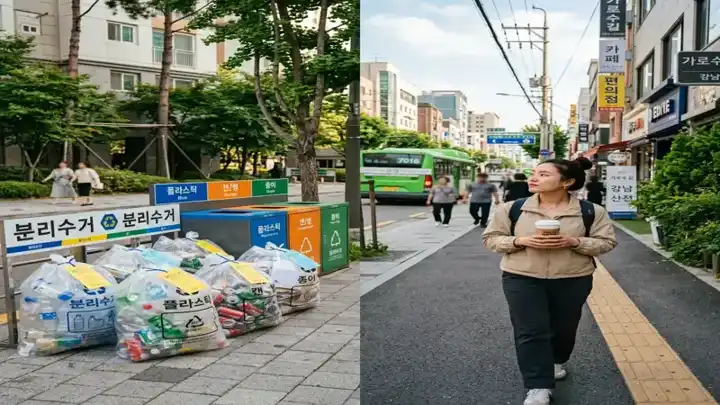
Quick Practical Waste Disposal Guide for Tourists in Korea
- On-the-Go Disposal: Use public bins where provided and follow posted sorting instructions. Shop bins are subject to each store’s policy; if you cannot find a suitable bin, carry the waste back to your accommodation.
- Food Waste: Sorting rules and exceptions vary by local government. Bones, hard pits, and shells are common examples of general waste; check the current district guidance.
- Official Trash Bags: If staying in an Airbnb, buy official volume-based bags (General & Food waste) at the counter of a local convenience store in your district.
- Recycling Habit: Rinse plastic containers thoroughly and peel off plastic labels before putting them into designated recycling bins.
What This Guide Covers
- Two Historical Reasons Why Public Trash Bins Vanished in Korea
- Four Practical Ways for Tourists to Handle Trash on the Street
- Can Livestock Eat It? How to Separate Food Waste from General Waste
- How to Buy Official Pay-as-You-Throw Bags at Convenience Stores for Airbnb Stays
- Essential Rules for Sorting Plastics, Cans, and Glass Bottles
One of the most surprising culture shocks for first-time visitors to South Korea is the near-total absence of public trash cans on city streets. It is common to see tourists carrying takeaway cups or snack wrappers for several blocks before they find a place to throw them away.
At first, this feels inconvenient, but once you understand the background, the reason becomes clear. Korea used to have more street bins, but sanitation problems and illegal dumping pushed officials to remove many of them. Today, Korea’s waste management system is among the strictest and most sophisticated in the world, and visitors can handle it smoothly if they follow a few basic rules.
Two Historical Reasons Why Public Trash Bins Vanished in Korea
The lack of public trash cans in Korean cities is not a sign of neglected municipal maintenance, but rather the result of a deliberate policy shift.
One major policy change was the introduction of the Pay-as-You-Throw System (Jongnyangje) in 1995. The system charges for household waste through designated bags or other local methods. Public-bin policy also changed over time, but the reasons and timing varied by place; the history should not be reduced to a single national cause.
Some public-transit bins were removed or changed for security and waste-management reasons. Policies differed by facility and period, so follow the signs at each location.
Bin availability varies by neighborhood and facility; check posted signs rather than assuming a bin is available at every station or tourist spot.
Four Practical Ways for Tourists to Handle Trash on the Street
Fines for improper disposal depend on the type of violation and local rules. Use designated bins when available; otherwise, take your waste to an approved disposal point at your accommodation.
- Use designated public bins: Sort your waste according to the signs where bins are provided. Not every station has the same bins.
- Check store rules: Use a shop’s bins only according to its posted policy; a store may not accept outside waste.
- Look for facility bins: Check parks and transit facilities for designated bins, following local signs.
- Carry a small bag: If you cannot find a bin, keep the waste with you until you reach an approved disposal point.
Can Livestock Eat It? How to Separate Food Waste from General Waste
Food waste is collected separately and can be processed into products such as animal feed, compost, or biogas. Detailed sorting rules and exceptions vary by local government. Bones, hard pits, and shells are common examples of general waste. Check the current guidance for your accommodation’s district. (Ministry of Environment food-waste guide; Seoul guidance for foreign residents)
Many visitors inadvertently confuse food scraps with general garbage. Here is how to distinguish them correctly:
- Dispose of in General Waste (Non-Food):
- Bones: Chicken bones, pork/beef rib bones, large fish bones
- Shells: Clam shells, oyster shells, crab/shrimp shells
- Eggshells: Chicken or quail eggshells
- Hard Seeds: Peach, plum, and cherry pits
- Tea bags and herbal tea dregs
- Dispose of in Food Waste:
- Soft fruit peels like banana or apple peels
- Leftover rice, noodles, and soft cooked side dishes
Any hard, sharp, or indigestible items must go into a general waste bag.
How to Buy Official Pay-as-You-Throw Bags at Convenience Stores for Airbnb Stays
If you are staying in an Airbnb or guesthouse rather than a hotel, you are responsible for taking out your own trash. Throwing garbage in ordinary plastic shopping bags will lead to uncollected trash and potential fines.
You must buy official Jongnyangje bags at convenience stores (CU, GS25, Seven-Eleven) or supermarkets in your neighborhood.
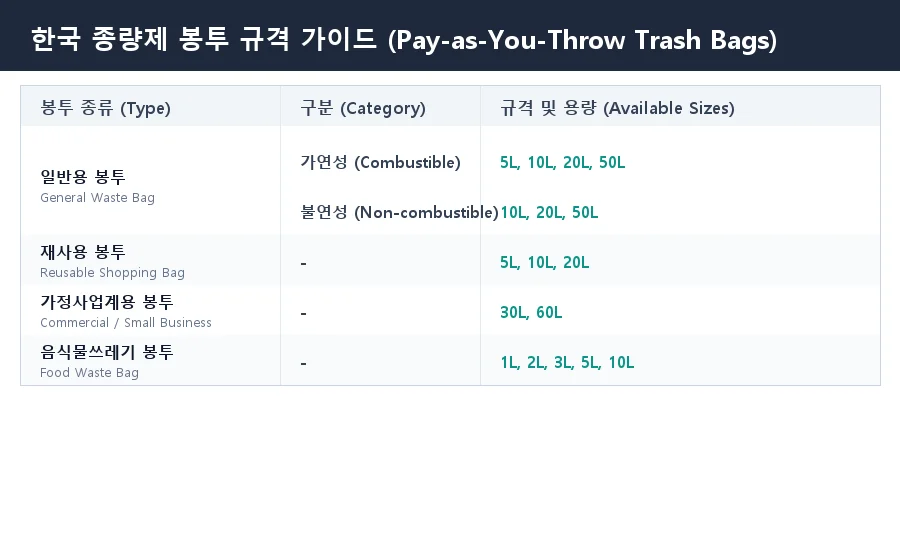
You can ask the cashier at the counter:
- For General Trash: "General trash bag 10 liters, please." (il-ban ssu-rae-gi bong-tu 10-liter ju-se-yo)
- For Food Waste: "Food waste bag 2 liters, please." (eum-sik-mul ssu-rae-gi bong-tu 2-liter ju-se-yo)
Note that bag colors and size rules vary by district (for example, Mapo-gu, Gangnam-gu, and Jongno-gu), so it is safest to buy them at a convenience store in the same district as your accommodation.
Essential Rules for Sorting Plastics, Cans, and Glass Bottles
Recycling in Korea is highly structured. Follow these three golden rules before tossing items into recycling bins:
- Empty & Rinse: Flush out leftover liquid or sauce with clean water.
- Unlabel: Remove plastic wrappers or labels from PET bottles and throw the label into vinyl recycling.
- Sort by Material: Place items in designated bins for Transparent PET, Mixed Plastics, Glass Bottles, Aluminum Cans, Paper/Boxes, and Vinyl/Plastic Wrappers.
Korea’s clean streets and efficient waste system depend on shared responsibility from everyone, including visitors. Following these simple rules will make your trip more comfortable and more pleasant.
📌 Recommended Posts
이 리뷰를 한국어로 읽고 싶으신가요?
🇰🇷 한국어 리뷰 읽기