Somaek and Hoesik: Unpacking K-Drama Drinking Culture
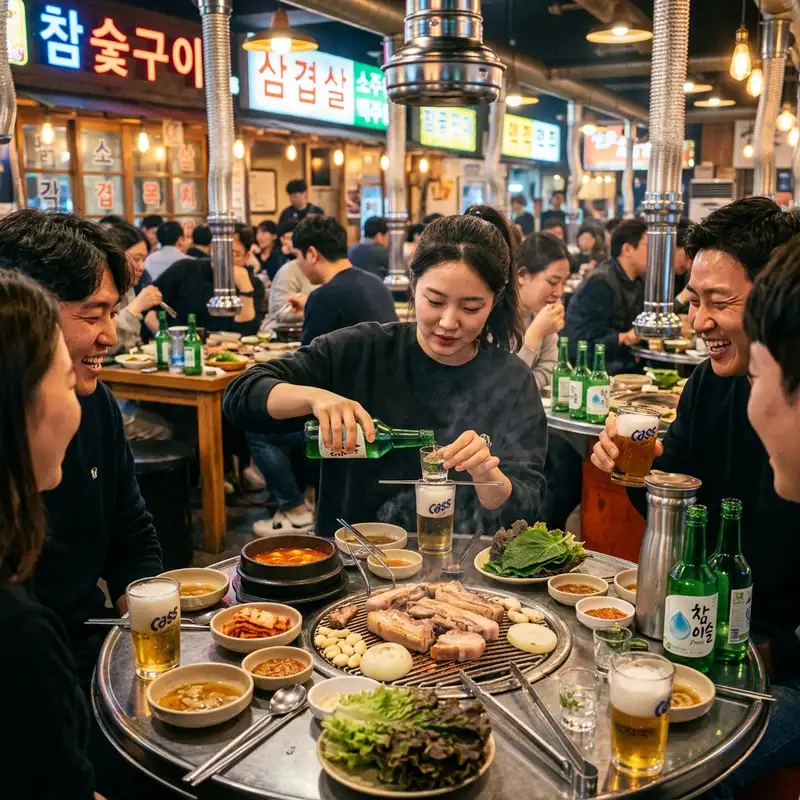
When watching Korean dramas or movies, you often see characters gathering at a pork belly BBQ restaurant after work, clinking their glasses. The sight of them mixing Soju into glasses of beer or playing noisy games while drumming on the table might seem quite unique to foreign viewers. At the heart of Korea's nightlife and 'Hoesik' (company dinner) culture lies 'Somaek', the iconic Korean bomb shot.
How to Make Somaek: The Whirlpool Technique
- 'Somaek', a Korean bomb shot made by mixing Soju and beer
- The performance of striking the glass to create a creamy foam whirlpool
- The perfect blend of Soju's thrilling kick and beer's refreshing coolness
Even nowadays, whenever I meet up with friends on the weekend or attend a company Hoesik on a weekday, we invariably start with Somaek. In the past, drinking only Soju used to give me an upset stomach and got me drunk too quickly, so I started mixing it with beer. Before I knew it, this had become the most natural way to kick off a gathering and felt like it had settled into a massive cultural norm.
There is no strict recipe—everyone mixes it to their own taste. But usually, you pour the beer into a glass first, then drop in a shot of Soju. After that, we strike the inside of the glass with a chopstick or spoon—clink!—instantly creating a white 'whirlpool'. The reason for making this whirlpool isn't just for show. It mixes the Soju and beer perfectly, maximizing the thrilling kick of the Soju and the refreshing coolness of the beer. The excellent taste as you gulp down that cold glass is enough to wash away all the stress of the day.
> [!NOTE] > **Hoesik (회식)**: Hoesik is a traditional Korean company dining culture where colleagues gather after work to eat, drink, and bond. It is considered an extension of work, aimed at breaking the ice and building a stronger sense of teamwork and community.Drinking Games and Building Camaraderie
- Various drinking games that liven up the mood and break the ice
- Anju (drinking snacks) culture featuring BBQ, stews, and pancakes that pair perfectly with alcohol
- Building camaraderie through cheering and pouring drinks for one another
A Korean drinking gathering is never just about consuming alcohol. Especially among college students and young professionals, drinking games are essential. Through simple games like 'flicking the bottle cap' or 'guessing the number', people engage in a battle of wits to avoid the penalty shot, quickly laughing and chatting with those who were previously awkward strangers. I also remember sweating nervously during my rookie days, trying to avoid game penalties while drinking Somaek mixed by my seniors.
The Perfect Pairing: Samgyeopsal and Somaek
- Somaek's strong carbonation washing away the grease of pork
- A modern, hygienic Anju culture where everyone makes their own Ssam
- The ultimate gastronomic experience created by a glass of Somaek and a piece of pork belly
At Korean drinking gatherings, especially where Somaek is served, there is almost always Samgyeopsal (pork belly) sizzling on the grill. Drinking only Soju doesn't quite cut through the grease, and drinking only beer makes you too full to eat much meat. However, mixing the two into Somaek provides the perfect balance: the rich carbonation of the beer cleanses the palate, while the alcohol of the Soju elevates the flavor of the meat. Whenever I go to a BBQ restaurant with my colleagues after work, it’s my long-time habit to sit down and immediately shout, "Auntie, three portions of Samgyeopsal, one Soju, and two beers, please!"
When the meat is cooked just right, everyone makes their own Ssam (lettuce wrap) by placing a piece of meat, garlic, and ssamjang on a lettuce leaf according to their own taste. In the past, people thought that feeding each other Ssam or passing around a single shot glass was a sign of 'Jeong' (affection). But now, unless it's among very close friends, the culture has completely shifted to a cleaner, more hygienic one where everyone eats from their own plate and drinks from their own glass. As you chew the Ssam you made with your own hands and gulp down an ice-cold Somaek, you experience the ultimate culinary delight, envying no one else in the world.
From Mandatory Dinners to Meaningful Connections
- The recent shift away from traditional top-down, boss-centered Hoesik
- The taste of 'real' Somaek enjoyed in a free, unforced atmosphere
- A warm time to console each other's hard work and end the day
Twenty years ago when I was a rookie employee, Korean Hoesik could be quite exhausting. There was a strong hierarchical atmosphere where you couldn't refuse a drink offered by your boss, and the drinking often continued into the late night for a second or third round. But as times have changed, today's Hoesik culture is entirely different. The culture of forcing drinks or passing glasses around is gradually disappearing, transforming into a gathering where people can drink just one or two glasses of Somaek at their own pace without feeling pressured, focusing on genuine communication.
With a freer atmosphere, the drinking gatherings have actually become much more enjoyable. Now, without anyone forcing it, we naturally pour Soju into our beer glasses, create whirlpools, and laugh together. The tight-knit solidarity felt when clinking our own glasses and saying, "You really worked hard today." This is the true reason why Koreans can't help but love Somaek and Hoesik, far beyond just consuming alcohol.
Practical Guide to Korean Drinking Culture for Tourists
Korean drinking gatherings are lively and affectionate, but there are a few unique etiquettes that might be unfamiliar to foreigners. Here are some tips to keep in mind when drinking with Korean friends.
- The Golden Ratio of Somaek: The most beloved Somaek ratio among Koreans is 3 parts Soju to 7 parts Beer. (Note: This doesn't mean mixing 3 whole glasses of Soju with 7 whole glasses of beer; it means filling a single beer glass to 30% with Soju and 70% with beer.) Also, using a crisp and light Korean lager (like Cass or Terra) is much smoother and pairs better than a strong-flavored Ale.
- Local Tip: After pouring the Soju and beer, press a spoon or chopstick against the bottom of the glass and strike it sharply! The sudden impact will create fine carbonation bubbles, allowing you to enjoy a smooth, creamy 'Cream Somaek'.
- The Two-Handed Etiquette and Turning Your Head: In Korea, you must always use two hands when pouring or receiving a drink from someone older or of higher status. (Hold the bottle or glass with one hand, and lightly rest your other hand on your wrist or chest.) Also, it is polite to turn your head slightly to the side when drinking in front of elders.
- How to Politely Refuse Alcohol: If you cannot drink, there is no need to force yourself. Saying Mot ma-syeo-yo (I cannot drink) sounds much more polite than 'I will not drink.' If you add that it's for health or religious reasons, no one will force you. Instead, just fill your glass with cola or water, shout Jjan! (Cheers!) with everyone, and enjoy the atmosphere.
Food as Comfort: The Deep Meaning of Sharing Meals & Drinking in K-Dramas
Explore why asking 'Have you eaten?' is the ultimate expression of love and healing in Korean culture.
📌 Recommended Related Posts
이 리뷰를 한국어로 읽고 싶으신가요?
🇰🇷 한국어 리뷰 읽기